Cornell Notes: Master Your Learning with This Powerful Method
Want to actively learn this topic?
LernPilot automatically creates quizzes, flashcards, and summaries from any topic.
Cornell Notes: The Ultimate Strategy for Effective Learning and Retention – Your Path to Knowledge Mastery
Imagine if you could not only understand every lecture, meeting, and text, but also retain what you've learned effortlessly and long-term. Sounds like a dream for any student, professional, or lifelong learner constantly seeking to expand their knowledge? With the Cornell Method, this dream becomes a reality. It's a proven learning strategy enthusiastically adopted by students, professionals, and lifelong learners worldwide for decades.
In this comprehensive article, we'll delve deep into the world of Cornell Notes. We'll show you not only how they work, but also why they are so incredibly effective. We'll explore the scientific principles underpinning their efficacy, provide concrete examples and practical tips, and explain how to optimally integrate them into your daily learning routine – both analog with pen and paper, and digitally with modern tools, and even in combination with AI-powered learning platforms like LernPilot. Prepare to revolutionize your note-taking habits and unlock your full learning potential!
What Are Cornell Notes and Why Are They So Revolutionary?
The Cornell Method is far more than just a note-taking system; it's an active learning strategy that compels you to engage in a dialogue with the learning material. It was developed in the 1950s by Professor Walter Pauk at the renowned Cornell University. Pauk, a pioneer in learning research and author of the bestseller "How to Study in College," recognized that traditional note-taking was often passive and contributed little to the long-term retention of knowledge. Many students simply copied without truly understanding or processing. His method aimed to solve this problem by encouraging learners from the outset to actively process, reflect on, and systematically review the material.
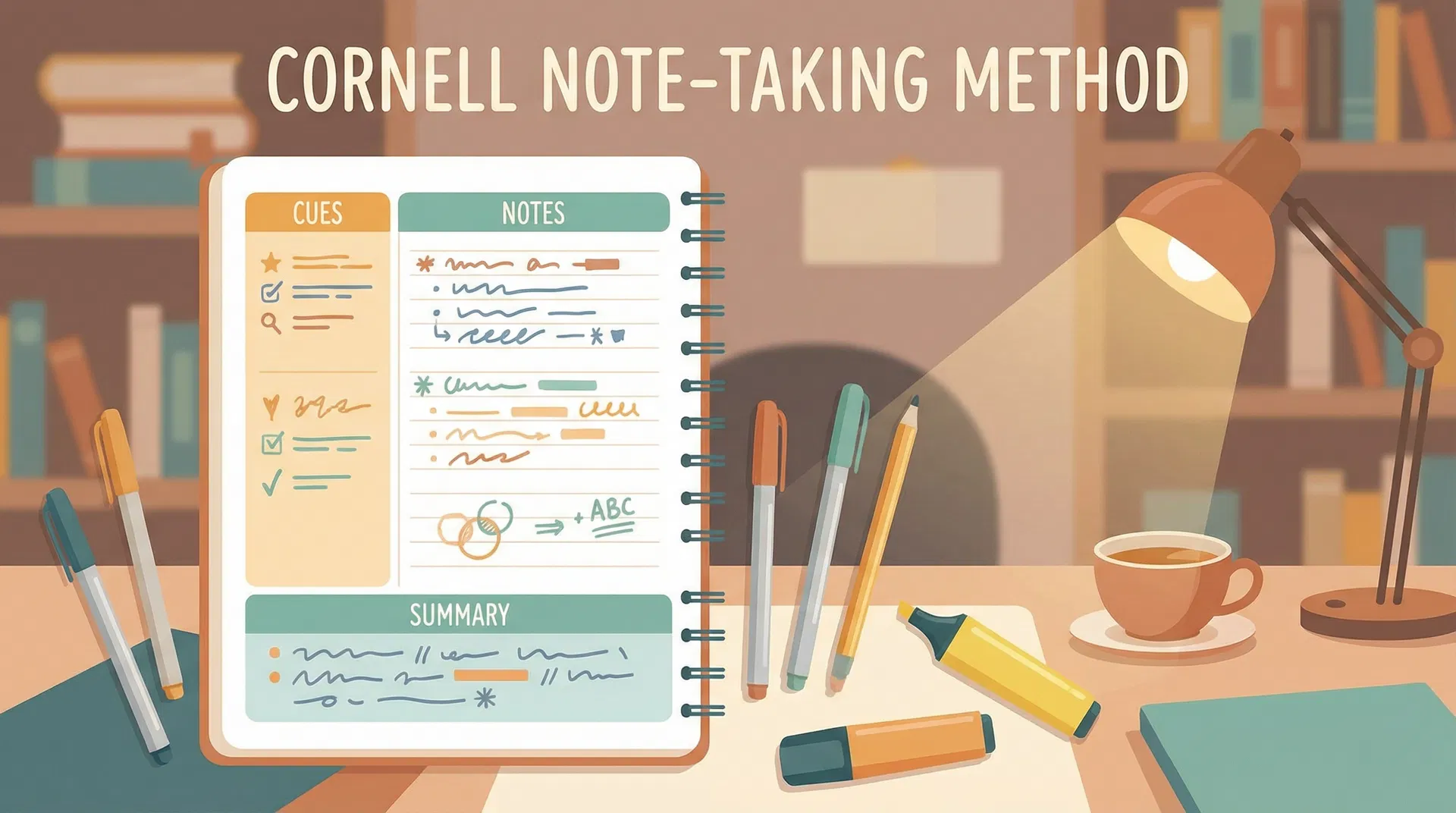
The core of the method lies in its simple yet ingenious structure, which divides the paper into three clearly defined areas. This division is not arbitrary but specifically designed to support different, psychologically sound phases of the learning process: efficient information intake, in-depth processing and elaboration, and systematic, retrieval-based review. It's a holistic approach that challenges and fosters the brain on multiple levels.
The Three-Column System: Your Note Page as an Intelligent Learning Tool
The heart of the Cornell Method is the unique division of your note page. Whether physical on paper or digital on a tablet or computer, the structure remains the same and is key to its exceptional effectiveness:
-
The Main Note-Taking Area (right, approx. 2/3 of the page): This is the primary area where you record your notes during the lecture, meeting, or while reading a text. The goal here is to capture core information, facts, concepts, definitions, examples, and explanations. Think bullet points, short sentences, diagrams, sketches, and abbreviations. The focus is on grasping the essence of what is said or read, not transcribing every word. Deliberately leave space for later additions or clarifications. This area is your raw data collection, your memory log of the moment.
-
The Cue/Keyword Area (left, approx. 1/3 of the page): This narrower strip on the left margin remains blank during the initial note-taking. Its true magic unfolds after the lecture or reading, ideally within 24 hours. Here, you formulate key questions related to the content in the main note-taking area, noting important keywords, concepts, people, formulas, dates, or central ideas. These questions and keywords should serve as memory aids, summarizing, pinpointing, or prompting reflection on the content of the right-hand area. They are the perfect trigger for later reviews and self-tests, as they facilitate the retrieval of information from memory.
-
The Summary Area (bottom, approx. 5-7 lines): This area also remains blank during the initial note-taking. It is filled in after the lecture or reading. Here, you write a concise summary of the entire page in 2-3 precise sentences. The goal is to articulate the main statements, the core theme, and the most important insights of the page in your own words. This forces you to condense, prioritize, and extract the most crucial points from what you've learned. The summary provides a quick overview and is excellent preparation for later reviews, helping you grasp the big picture.
Why the Cornell Method Works So Exceptionally Well: The Science Behind It
The effectiveness of the Cornell Method is no accident; it is based on solid and extensively proven principles of cognitive and and learning psychology. It utilizes several established techniques that strengthen memory, deepen understanding, and promote long-term retention of information. Let's take a look at the scientific pillars upon which this method rests:
1. Active Processing and Elaboration: Learning Deeper, Not Just Superficially
One of the main reasons for the Cornell Method's success is the active processing of the learning material. While passive listening or mere copying often leads only to superficial learning, the Cornell Method forces you into a deeper, more elaborative engagement with the material:
- Triple Encoding: You process the material not just once (during initial note-taking), but three times: when noting main content, when formulating keywords/questions, and when writing the summary. Each of these phases is a form of elaboration, where you link new information with existing knowledge, rephrase it in your own words, and place it within a larger context. Studies, such as those by Craik and Lockhart (1972) on the Levels of Processing framework, have shown that deeper processing leads to a stronger, more durable, and more easily retrievable memory trace. You thus form richer and more stable mental representations of knowledge.
- Generation Effect: Actively formulating questions and summaries (generation) is, according to research, more effective than simply re-reading or passively receiving information. The generation effect (Slamecka & Graf, 1978) states that information is better remembered when actively produced by the learner, rather than just read or heard. By asking questions and summarizing content yourself, you force your brain to actively reconstruct and organize knowledge, which significantly improves memory formation.
2. Metacognition and Self-Regulation: Becoming Your Own Learning Coach
The method fosters your metacognitive skills – thinking about your own thinking and learning. When formulating questions in the cue area, you must identify what is important, what connections exist, and which aspects you haven't fully understood yet. This sharpens your awareness of your own learning process, your strengths and weaknesses, and enables you to specifically address knowledge gaps. It is an act of self-regulation that helps you take control of your learning and become more effective. You learn how to learn.
3. Retrieval Practice: Actively Training Your Memory
The cue area serves as a built-in self-test. By later covering the main note-taking area and attempting to recall the content solely based on the keywords or questions, you engage in retrieval practice. This is one of the most powerful learning strategies, as a multitude of studies, including those by Roediger and Karpicke (2006), have shown. Each successful retrieval strengthens the memory trace and makes it more likely that you can recall the information in the future. It is exponentially more effective than mere re-reading, as it simulates the process you will need later in an exam or application situation.
4. Spaced Repetition: Outsmarting Forgetting
Although not explicitly part of the original method, the Cornell Method can be excellently combined with spaced repetition. By reviewing your Cornell notes at regular, progressively longer intervals (e.g., after 24 hours, after a week, after a month), you utilize the effect of distributed learning. This counteracts natural forgetting, described by Ebbinghaus's forgetting curve, and consolidates knowledge in long-term memory.
5. Structure and Organization: The Brain Loves Order
The clear, predefined structure of Cornell notes helps to organize and categorize information. This reduces the cognitive load often associated with note-taking and facilitates the later retrieval, linking, and understanding of information. The brain loves structure because it helps to reduce complexity and integrate new information more efficiently into existing knowledge networks. The visual separation of the areas also supports clear thought processes.
Step-by-Step Guide: How to Apply and Perfect the Cornell Method
The beauty of the Cornell Method lies in its simplicity and adaptability. Here's a detailed guide on how to use it optimally to maximize your learning:
Phase 1: Preparation – Designing Your Note Page
Before you start, prepare your note page. You can do this manually or use a template – whether on paper or digitally:
- Draw the horizontal line: Draw a horizontal line about 5-7 lines (or 5 cm) from the bottom edge of the page. This is your summary area.
- Draw the vertical line: Draw a vertical line about 6-7 cm from the left edge, extending down to the horizontal line. This divides the upper area into the main note-taking area and the cue area.
Your Cornell template is ready! You can also buy special Cornell notebooks, use digital templates, or create a template yourself in note-taking apps like OneNote or Notion.
Phase 2: During the Lecture/Reading – Focus on the Main Note-Taking Area
In this phase, focus exclusively on the right, large main note-taking area. Your goal is to capture the most important information efficiently and concisely:
- Bullet points instead of sentences: Write as much as necessary, but as little as possible. Use bullet points, phrases, and keywords instead of full sentences. This saves time, allows you to keep up with the speaker, and forces you to condense and filter information even while taking notes.
- Abbreviations and symbols: Develop your own consistent system for abbreviations (e.g., "e.g." for "for example," "&" for "and," "->" for "leads to," "≠" for "not equal") and symbols (e.g., "!" for important, "?" for question, "*" for definition, "Δ" for change). This significantly speeds up note-taking and makes your notes more personal and efficient.
- Visual elements: Integrate small sketches, diagrams, simple mind maps, or flowcharts if they help visualize complex relationships. A picture often says more than a thousand words and can make complex information understandable at a glance.
- Leave space: Deliberately leave gaps between bullet points or sections. This facilitates later additions, corrections, or the inclusion of examples or your own thoughts without clutter.
- Separate topics: When a new main topic begins, mark it clearly (e.g., with a new heading, a horizontal line, or an asterisk). For major topic changes, it may be useful to start a new page to maintain clarity.
- No perfectionism: The goal is not to create the most beautiful or complete notes, but to capture the most important information. Refinement and organization come later in Phase 3.*
Phase 3: Within 24 Hours – Processing and Deepening (The Crucial Phase!)
This is the critical phase of the Cornell Method and should never be skipped. Ideally, you should dedicate about 10-15 minutes per page within 24 hours after the lecture/reading. Why 24 hours? Because the forgetting curve is steepest in the first hours after learning. An early review effectively counteracts this.
-
Fill in the Cue Area: Carefully read through your notes in the right-hand area. Identify the main concepts, keywords, names, dates, formulas, and important ideas. Then, in the left cue area, formulate questions that answer the content of the right-hand area. These questions should be thought-provoking and not just allow for yes/no answers. Examples:
- Instead of: "Definition of photosynthesis" -> Question: "What is photosynthesis, what components are involved, and what role does it play for life on Earth?"
- Instead of: "Important dates for the French Revolution" -> Question: "What key events shaped the French Revolution, when did they occur, and what long-term consequences did they have?"
- Instead of: "Formula for kinetic energy" -> Question: "How is kinetic energy calculated, and what physical principles underlie it?"
- You can also note simple keywords that serve as reminders, e.g., "Cognitive Dissonance – Definition & Examples" or "Pythagorean Theorem – Application & Proof." The goal is to activate and organize the content of the main note-taking area through these questions.
-
Highlight important points: Use highlighters or colored pens to emphasize particularly important definitions, formulas, concepts, or critical information in the main note-taking area. But be careful: don't overdo it; less is often more. A page that is too colorful loses its clarity. A good rule of thumb is to highlight no more than 10-15% of the text.
-
Write the Summary: Read the entire page (main note-taking and cue area) again. Then, in the bottom summary area, summarize the main statements, the core theme, and the most important insights of the page in 2-3 concise, complete sentences. Formulate this in your own words to ensure that you have truly understood and internalized the content. This summary should provide you with a quick overview of the page's core even weeks later.
Phase 4: Regular Review – Ensuring Long-Term Retention
The Cornell Method is an excellent tool for active review. This is where retrieval practice and spaced repetition come into play:
- Cover the main note-taking area: When reviewing your notes, cover the right-hand main note-taking area with a sheet of paper, your hand, or a digital tool.
- Answer the questions: Read the questions and keywords in the left-hand area. Try to formulate the answers and explanations aloud or in your mind, without looking at the main note-taking area. Try to recall as many details as possible and explain the connections.
- Check your answers: Uncover the main note-taking area and compare your answers with your notes. Correct errors, fill in gaps, and clarify ambiguities. Be honest with yourself about what you truly knew and what you didn't.
- Review the summary: Read the summary at the bottom to get a quick overview and consolidate the main points. This helps keep the big picture in mind.
- Spaced intervals: Review your notes at progressively longer intervals (e.g., after 1 day, 3 days, 1 week, 2 weeks, 1 month). This is key to applying the spaced repetition effect and transferring knowledge to long-term memory. Firmly schedule these review sessions into your study plan.
Digital Cornell Notes: The Method in the 21st Century
Even though the Cornell Method is traditionally associated with pen and paper, it can be excellently transferred to the digital world. Modern tools and apps even offer additional advantages that can make note-taking and reviewing even more efficient:
Apps and Software for Digital Cornell Notes
Many note-taking apps and word processors can be adapted for Cornell notes. Here are some popular options:
- OneNote (Microsoft): Offers flexible page layouts where you can easily create columns and sections. You can integrate text, images, audio recordings, videos, and even web clippings. The search function is powerful, and notes can be synchronized across devices.
- Evernote: Similar to OneNote, Evernote allows you to create notebooks and notes with flexible layouts. Tags and powerful search functions help with organization.
- Notion: An all-in-one workspace solution that is excellent for Cornell notes. You can create databases, tables, and pages with custom columns to represent the three areas. Linking notes and integrating media are seamless.
- GoodNotes, Notability (for tablets with stylus input): These apps are ideal for handwritten digital notes. You can import Cornell templates or draw them yourself and then write in the areas by hand. The big advantage is the handwriting search function and the ability to link audio recordings directly to your notes.
- Word or Google Docs templates: For simple implementation, you can quickly create table structures in these programs to represent the three areas. Many free templates are also available online.
Advantages of Digital Cornell Notes
- Flexibility and editability: Content can be easily edited, moved, supplemented, and reformatted without becoming messy. This is particularly useful as your understanding of the material deepens or you add new information.
- Powerful search function: Digital notes are searchable, which significantly facilitates finding specific information, keywords, or concepts, even in a vast archive of notes.
- Media integration: You can embed links to external sources (websites, scientific articles), videos, audio recordings, or other documents directly into your notes. This creates rich, interconnected learning material.
- Organization and categorization: Digital notes can be easily categorized, tagged, filed in folders, and provided with metadata. This ensures a clear structure and quick access.
- Collaboration: Many digital tools allow for collaboration on notes, which can be beneficial for group projects or shared study sessions.
- Accessibility: Digital notes can be more easily enlarged, exported to other formats, or used with screen readers.
LernPilot and the Cornell Method: An Unbeatable Combination
The combination of the structured Cornell Method with the intelligent features of an AI learning platform like LernPilot elevates your learning to a whole new level. Imagine optimally leveraging the benefits of both worlds:
- You create your Cornell notes – either traditionally analog with pen and paper and then scan them, or directly digitally in an app of your choice (e.g., GoodNotes, OneNote, Notion).
- You upload your notes to LernPilot. Our advanced AI analyzes the content of your main note-taking area as well as your self-formulated questions and keywords in the left-hand area. It understands the structure and core information of your notes.
- Automatic flashcards: LernPilot identifies key concepts, definitions, connections, and important facts from your notes. Based on this, the AI automatically generates digital flashcards. Your self-formulated questions from the cue area can be directly used as questions on the flashcards, enhancing the retrieval effect.
- Interactive quizzes: The AI can even go a step further and create multiple-choice questions, fill-in-the-blanks, true/false statements, or short answer questions based on your notes. This transforms your passive notes into a dynamic, interactive quiz that tests and reinforces your understanding in a playful way.
- Intelligent Spaced Repetition System: LernPilot integrates an intelligent spaced repetition system. The generated flashcards and quiz questions are presented to you at optimal, increasing intervals, based on your individual learning progress and memory performance. This way, you consolidate knowledge in long-term memory – exactly as research on distributed learning recommends, but automated and personalized.
- Personalized learning paths and analytics: The AI identifies knowledge gaps based on your answers and suggests personalized learning paths. You receive detailed analytics of your learning progress, which helps you focus on the areas you need most.
This synergy means you fully exploit the benefits of active processing, elaboration, and retrieval practice through the Cornell Method, while simultaneously enjoying the efficiency, personalization, and automation of an AI-powered learning platform. It's the perfect bridge between proven learning strategy and cutting-edge technology, helping you learn faster, deeper, and more sustainably.
Common Mistakes and How to Avoid Them: Pitfalls on the Path to Learning Mastery
Even the best method can fail if not applied correctly or consistently. Here are some typical pitfalls learners encounter with the Cornell Method, and how to cleverly avoid them to unlock its full potential:
-
Mistake 1: Filling in the cue and summary areas during the lecture.
- Solution: Resist this temptation! These areas are explicitly for post-processing. Your brain needs time to process, condense, and reflect on the material. Filling them in during the lecture leads to superficial notes, as you cannot concentrate on listening, and misses the crucial processing step that makes the method so effective. Phase 3 is key!
-
Mistake 2: Writing too much in the main note-taking area (transcribing everything).
- Solution: This is a common mistake with traditional note-taking. With Cornell notes, focus on key information, bullet points, concepts, and the essence of what is said. Use abbreviations and symbols. The goal is to filter and condense information, not to transcribe every word. This forces you to actively select and process information even during initial note-taking, which promotes understanding.
-
Mistake 3: Skipping or postponing the post-processing step (Phase 3).
- Solution: This is the most critical mistake and deprives the Cornell Method of much of its effectiveness. Without formulating questions and summarizing, there is no active elaboration and deeper processing. Schedule this time firmly, ideally within 24 hours after the lecture/reading, to effectively slow down the natural forgetting process and strengthen memory traces. Consider it an integral part of learning, not an optional task.
-
Mistake 4: Asking questions that are too specific or only require a yes/no answer.
- Solution: Formulate questions that encourage critical thinking, require a more detailed answer, and force you to make connections. Use W-questions (Who, What, When, Where, Why, How) and formulate them to inquire about concepts, definitions, and relationships. For example: Instead of "Was the French Revolution in 1789?" better "What causes led to the French Revolution in 1789, and what phases did it go through?" This promotes deep retrieval.
-
Mistake 5: Not reviewing notes regularly.
- Solution: The Cornell Method is a tool for active learning and long-term retention, not just for note-taking. Without regular review, especially using retrieval practice, much of its effect is lost. Integrate fixed review sessions into your study plan to consolidate knowledge long-term and counteract forgetting. Actively use retrieval practice by covering the main note-taking area and testing yourself.
-
Mistake 6: The summary is too long or just a copy of the main note-taking area.
- Solution: The summary should be concise – 2-3 sentences that capture the core theme and main statements of the page in your own words. It is not a re-listing of bullet points, but a synthesis. This forces you to identify and articulate the essentials.
Practical Tips for Optimizing Your Cornell Notes: Become a Note-Taking Master
To get the most out of the Cornell Method and adapt it optimally to your individual needs, here are some proven tips that go beyond the basic instructions:
- Strategic color-coding: Use different colors for headings, definitions, examples, open questions, or important formulas. This creates visual hierarchies, facilitates quick retrieval of information, and helps identify different information types instantly. Don't overdo it; two to three colors are often sufficient and more effective than a rainbow.
- Establish symbols and icons: Develop a consistent system of symbols to mark notes (e.g., an asterisk for particularly important points, a question mark for things you need to look up, an arrow for references to other pages or chapters, an exclamation mark for warnings or common mistakes). This saves space and makes your notes more understandable at a glance.
- Make connections and use cross-references: If you recognize connections to other topics, previous lectures, or external sources, note this in the main note-taking area or even in the cue area (e.g., "See also: Notes from 12.03. Topic X"). This promotes interconnected thinking and helps you build a coherent knowledge network.
- Active listening/reading as a foundation: The Cornell Method works best when you actively listen or read from the start. Try to recognize the structure of the presentation or text, identify the main arguments, and organize your notes accordingly. While doing so, already formulate questions that you can later put in the cue area.
- Regular review of notes (not just before exams): Go through your notes not only before exams but also periodically to stay on top of things and identify knowledge gaps early. A quick monthly review can work wonders to keep knowledge fresh.
- Adaptation to context and subject area: The method is flexible and should be adapted to the respective content. For a math or physics lecture, the main note-taking area might contain many formulas, equations, and example calculations, while the cue area would formulate the underlying principles, solution strategies, and derivations. For a history lecture, it would be more about dates, names, causal relationships, and interpretations.
- Use the bottom area for action items or open questions: If you use the method in a professional context (e.g., for meetings), the summary area can also be used for action items (Who does what by when?) or for open questions that still need clarification. In an academic context, this area can also contain questions you want to ask the lecturer or topics you still need to delve into.
- Mind maps or sketches as supplements: Don't hesitate to integrate small mind maps or sketches directly into the main note-taking area to visually represent complex relationships. Sometimes a picture is more effective than many words.
- Incorporate a feedback loop: If you are in a study group, discuss your Cornell notes. Other perspectives can help you sharpen your questions or discover gaps in your understanding.
Conclusion: Your Key to Sustainable Learning Success
The Cornell Method is far more than just a note-taking technique – it is a holistic learning strategy based on the fundamental principles of cognitive psychology. It forces you into active processing, fosters metacognitive skills, integrates effective retrieval practice, and combines excellently with spaced repetition. Through its clear structure and targeted division into main note-taking, cue, and summary areas, it optimizes every step of the learning process – from initial intake to long-term retention.
Whether you are a student, a professional, or simply a lifelong learner: consistent application of the Cornell Method will dramatically improve your ability to understand, retain, and recall information. It transforms passive notes into an active learning tool and helps you unleash your full learning potential. The investment of a few minutes after each learning session pays off many times over in deeper understanding and more sustainable memory. Use the power of this method to consolidate your knowledge and achieve your learning goals.
Want to apply these techniques directly? With LernPilot, you can learn AI-supported and optimize your learning strategies.
Ready to deepen this knowledge?
Upload your materials and LernPilot automatically creates flashcards, quizzes, and a personalized study plan.
No credit card required • Cancel anytime