Learning Type Myth: Why Evidence-Based Learning Really Matters
Want to actively learn this topic?
LernPilot automatically creates quizzes, flashcards, and summaries from any topic.
Learning Type Myth Debunked: How to Learn Really Effectively - The Scientific Approach
“I’m a visual learner,” “I have to hear it to understand it,” “I learn best when I do it myself.” We encounter such statements all the time, be it at school, at university or in our professional lives. The idea that every person has a specific, preferred learning style – be it visual, auditory, kinesthetic or reading/writing – is deeply rooted in our understanding of education. But what does modern learning research say about this? Is this popular classification really the key to effective learning, or is it a persistent myth that may even be preventing us from reaching our full learning potential? In this in-depth article, we dive deep into the science of learning, debunk common misconceptions, and show you which strategies really work to permanently anchor your knowledge.
The persistent myth of fixed learning styles: What the research really says
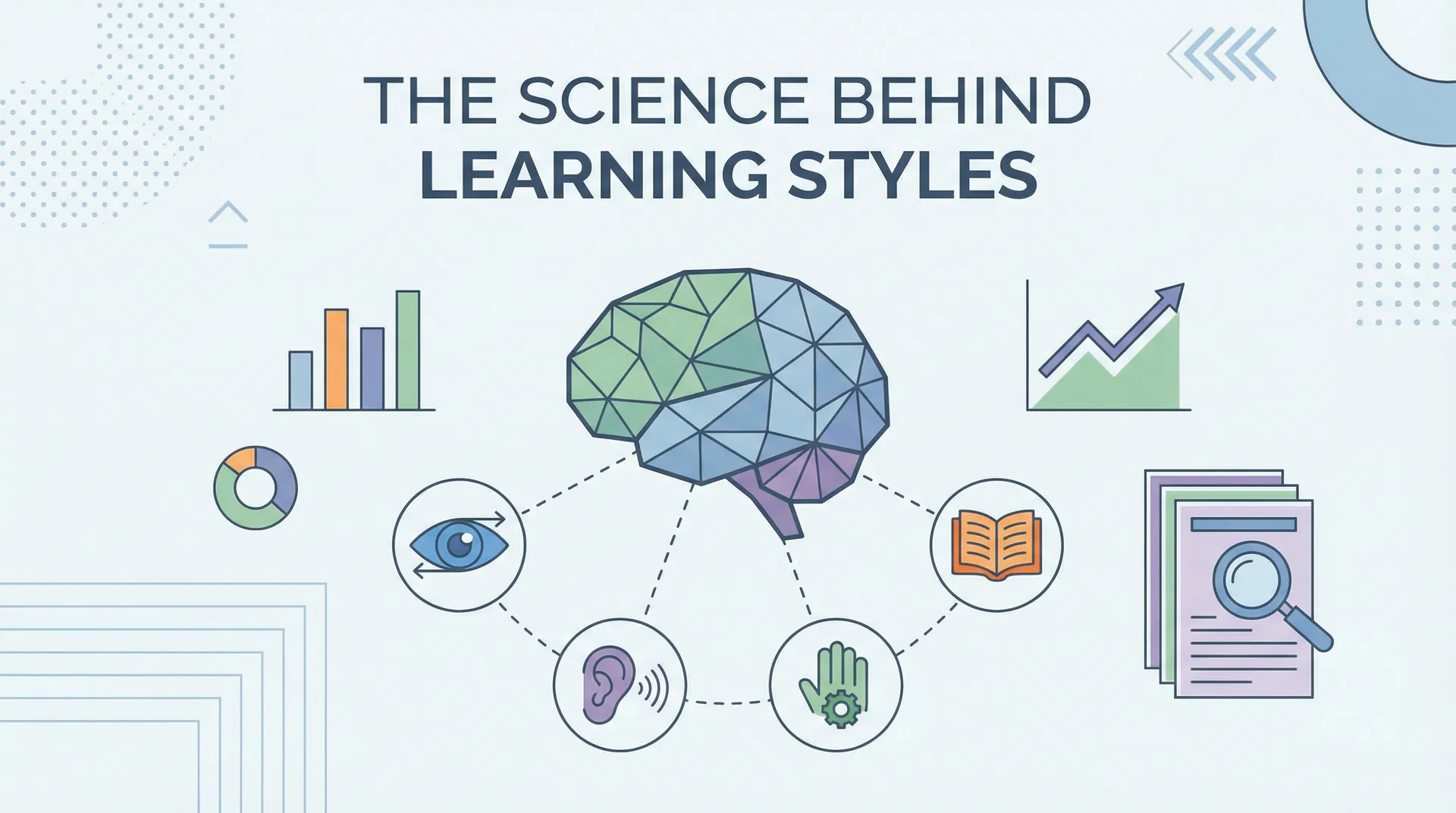
The idea of fixed learning styles, often based on models such as the VARK model (Visual, Auditory, Read/Write, Kinesthetic), is widespread. Many people identify strongly with a particular type and believe that they can only learn optimally when the material is presented in their preferred modality. But the scientific community agrees on this: There is no empirical evidence that adapting the teaching method to a supposed learning type increases learning success.
Why the learning type approach is scientifically untenable
Numerous studies have attempted to confirm the learning styles hypothesis. In 2008, a team led by Harold Pashler from the University of California, San Diego, examined the existing literature in a comprehensive review and came to the conclusion that not a single study could clearly prove the existence of learning types and their benefits for learning success. Later reviews, such as that by Coffield et al. (2004), confirmed this result and identified over 70 different learning style models, none of which met the strict scientific criteria for validity and reliability.
The problem lies in the so-called “meshing hypothesis”: the assumption that a match between an individual's preferred learning style and the way the learning material is presented leads to better learning outcomes. This hypothesis could repeatedly not be confirmed. For example, students who were classified as “visual” did not perform better when the material was presented visually than when it was presented auditorily or text-based.
What the research shows instead:
- Multimodal learning is most effective: Our brains are designed to process information from different channels at the same time. When you hear, see, talk about or apply a complex issue, different areas of the brain are activated, leading to a deeper and more stable anchoring of knowledge. This is the essence of the dual coding principle (Paivio, 1986), which states that combining verbal and visual information improves learning.
- The best method depends on the learning content, not the learner: It makes sense to learn geometry with visual diagrams, music theory auditorily or a new sport kinesthetically by trying it out. This is not about your personal learning style, but about the inherent nature of the learning material and the most efficient way to convey or process it. An “auditory learner” will have difficulty understanding a complex chemical structure just by listening when a visual representation would be much more meaningful.
- Variety in methods increases learning success: Instead of fixating on a supposed preference, our brain benefits from variation. Switching between different learning strategies keeps the brain active and prevents monotony. This promotes flexibility of thinking and the ability to encode and retrieve information in different ways.
The psychological reasons for the learning type belief
Why do learning types persist so stubbornly despite the lack of scientific evidence? There are several psychological explanations:
- Confirmation Bias: Once you believe that you are a visual learner, you will unconsciously look for evidence that confirms this belief and ignore contradictory information.
- Placebo Effect: If you believe that a particular learning method will work for you, that belief alone can improve your performance, regardless of the actual effectiveness of the method.
- Simplifying complex processes: The idea of learning types provides a simple explanation for individual differences in learning and relieves the need to engage with more complex, evidence-based strategies.
- Comfort Zone: It's comfortable to stick with a method that feels familiar, even if it's not the most effective.
What really works: Evidence-based learning methods for sustainable success
After debunking the myth of learning styles, let's turn to the strategies that have been confirmed to be highly effective by cognitive psychology and educational research. These methods are universally applicable and help everyone, regardless of perceived preferences, learn better.
1. Spaced Repetition (Distributed Learning)
What it is: Instead of learning everything at once (bulimia learning), you spread out your learning sessions over a longer period of time. Information is repeated at increasingly larger intervals, just before you would forget it.
Why it works: The Ebbinghaus forgetting curve shows that we quickly forget information if we don't repeat it. Spaced repetition counteracts this curve by scheduling repetitions exactly when our memory has to make the greatest effort to recall the information. This effort strengthens the memory trace. Studies by Dr. Piotr Wozniak, the developer of SuperMemo, has impressively demonstrated the efficiency of this principle.
Best for: Facts, vocabulary, formulas, definitions, dates, names - anything that needs to be memorized.
Practical implementation:
- Use flashcard systems (physical or digital like Anki or integrated into LernPilot) that are based on spaced repetition.
- Schedule regular review sessions that span days, weeks, and months.
- Start with short intervals and gradually lengthen them as you master the information.
2. Active Recall
What it is: Instead of passively reading or recapitulating information, you actively try to recall what you learned from memory without looking at your notes.
Why it works: Every time you successfully retrieve a piece of information, you strengthen the neural connections that lead to that information. This retrieval practice is one of the most powerful learning strategies. It's like a muscle that gets stronger with training. A review by Roediger and Karpicke (2006) showed that active retrieval is more effective than re-study of the material.
Best for: All content, from concepts to facts. It is the most universal and effective method.
Practical implementation:
- Self-tests: After each learning section, ask yourself questions about the material and answer them without any aids.
- Flashcards: Use flashcards to query definitions, concepts or formulas.
- Explain to someone: Try explaining what you've learned to someone else (or to yourself in the mirror).
- Mind Maps/Concept Maps: Draw a mind map from memory to show connections.
- Closed Book: Read a chapter, close the book, and write down everything you can remember.
3. Elaboration (Detailed Processing)
What it is: You ask yourself questions about the material you are learning, look for explanations, connect new information with what you already know and think about the meaning. It's about going deeper into the material instead of just staying on the surface.
Why it works: Elaboration promotes deep understanding by integrating new information into your existing knowledge network. The more connections you make to a concept, the easier it will be for you to recall and apply it later. It helps you understand the “why” behind the “what.”
Best for: Conceptual understanding, complex theories, connections.
Practical implementation:
- Ask questions: “Why is that?”, “How does this relate to X?”, “What if...?”.
- Analogy Formation: Find comparisons or metaphors to explain complex ideas.
- Find/invent examples: Concrete abstract concepts with your own examples.
- Discussions: Discuss the material with fellow students or friends.
- Self-explanation: Explain the connections to yourself out loud or in writing.
4. Interleaving (nested learning)
What it is: Instead of learning one topic area completely before moving on to the next (block learning), you switch between different but related topics or problem types within a study unit.
Why it works: Interleaving forces your brain to differentiate between different concepts and choose the right strategy for each problem. This not only promotes deeper understanding, but also the ability to problem identification and solution. A study by Rohrer and Taylor (2007) showed that interleaving significantly improved performance on math problems.
Best for: Problem solving, math, science, languages, skills that require different approaches.
Practical implementation:
- If you are studying for an exam that covers different topics, mix the practice problems from those topics instead of doing all the questions on Topic A and then on Topic B.
- When learning languages: Switch between grammar, vocabulary and listening comprehension in one session.
- When exercising: Train different movement sequences alternately instead of just perfecting one.
5. Dual Coding (Double Coding)
What it is: The combination of verbal information (text, spoken word) with visual information (images, charts, graphs, videos) to present the same content.
Why it works: Our brain has separate channels for processing verbal and visual information. When both channels are activated simultaneously, stronger and more diverse memory traces are created. This makes the information more redundant and therefore easier to access. It is important that the visuals complement the verbal information and not just repeat or distract.
Best for: Complex relationships, processes, structures, abstract concepts.
Practical implementation:
- Visualize notes: Create sketches, diagrams or infographics for your text notes.
- Use videos: Watch explainer videos that visually represent concepts.
- Mind Maps: Create mind maps that contain keywords as well as symbols and images.
- Tables and Matrices: Visually organize information into tables to highlight comparisons and relationships.
- Own drawings: Try to draw complex processes or structures yourself.
6. Concrete Examples
What it is: Abstract concepts and theories are made more understandable and tangible through concrete, illustrative examples.
Why it works: Our brains are naturally good at processing and storing concrete experiences. Abstract ideas can be difficult to grasp. By linking an abstract idea to one or more concrete examples, you create a bridge to your existing knowledge and experiences, making it easier to understand and remember. It helps to translate theory into practice.
Best for: Abstract theories, mathematical formulas, philosophical concepts, scientific principles.
Practical implementation:
- Find Examples: Look for examples of what you are learning in textbooks, online resources, or in everyday life.
- Invent your own examples: Try to generate your own relevant examples. This is a form of elaboration.
- Case Studies: Analyze case studies to see how concepts apply in the real world.
7. Self-regulation and metacognition
What it is: The ability to monitor, evaluate and adapt one's own learning process. It's about developing an awareness of how you learn and using strategies to improve.
Why it works: Effective learners are not only good at absorbing information, but also at managing their learning process. They know when they understand something and when they don't, which strategies work and which don't. Metacognition is the “conductor” of learning and allows you to use the methods mentioned above in a targeted and flexible manner. Studies show that metacognitive skills are highly correlated with academic success (Flavell, 1979).
Best for: Optimizing the entire learning process, adapting to new challenges.
Practical implementation:
- Set learning goals: Define clear, achievable goals for each learning unit.
- Learning planning: Create a realistic learning plan and stick to it.
- Self-reflection: Ask yourself regularly: “What have I learned?”, “What do I still not understand?”, “Which strategy worked well here?”, “What do I need to do differently?”.
- Error analysis: Understand why you made mistakes instead of just correcting them.
- Monitoring: Monitor your progress and adjust your strategies if necessary.
Find your optimal learning strategy: A step-by-step approach
Since there are no fixed learning styles, the path to effective learning is a process of experimentation, reflection and adaptation. Here is a practical guide to developing your personal, evidence-based learning strategy:
Step 1: Understand the learning content and learning objective
Before choosing a learning method, analyze what you need to learn and why. Is it about:
- Facts and Definitions? (Spaced Repetition, Active Retrieval)
- Complex concepts and theories? (Elaboration, Dual Coding, Concrete Examples)
- Problem-solving skills? (Interleaving, Active Retrieval)
- Practical skills? (Active recall, practice with feedback)
Every piece of content has its optimal approach. Be flexible in your choice of methods.
Step 2: Try different evidence-based methods
Leave your comfort zone and actively experiment with the strategies mentioned above. Use them consciously and observe the results.
- Active recall: Begin each study session by remembering what you last learned. Test yourself regularly with questions or flashcards.
- Elaboration: When learning a new term, ask yourself: “What does this mean in my own words?”, “Can I find an example of this?”, “How does it relate to other things I already know?”
- Dual Coding: When you read a text, try to present the most important information in the form of a sketch, diagram or mind map. When you watch a video, take notes in bullet points and try to explain the concepts in your own words.
- Spaced Repetition: Use digital tools or a physical flashcard system to review facts and vocabulary at regular intervals.
- Interleaving: When doing practice tasks, mix different task types or topics rather than focusing on just one.
Step 3: Always learn actively – Passivity is the enemy of learning
Passively reading, highlighting, or re-reading notes often creates the illusion of knowledge. You recognize the information, but that doesn't mean you can recall or apply it. Resist the temptation of passive consumption!
- Instead of just reading: Summarize, explain, ask questions, test yourself.
- Instead of just marking: Write the core statements in your own words in the margin, create a question about the marked section.
- Instead of just listening: Take notes, formulate questions, discuss what you hear.
Step 4: Test regularly and get feedback
Self-tests are not just a method for checking performance, but one of the most effective learning strategies of all. They force you to actively recall and show you mercilessly where the gaps in your knowledge are.
- Incorporate quizzes into each learning unit: Short quizzes, end-of-chapter questions, explaining concepts without notes.
- Use mistakes as learning opportunities: Analyze your mistakes to understand where the problems are. This is metacognition in action.
- Get feedback: If possible, have others quiz you or ask for corrections to your explanations.
Step 5: Work multimodally and create variety
Even if there are no fixed learning styles, your brain benefits from absorbing and processing information through different channels. This is the core of multimodal learning.
- Combine: Read a text, watch a relevant video, create a mind map, talk to someone about it, apply what you have learned practically.
- Vary your learning environment: Sometimes at the desk, sometimes in the library, sometimes in the coffee shop - new environments can help make what you learn less context-dependent.
- Change media: Use books, podcasts, online courses, discussion forums.
Step 6: Reflect and adapt (metacognition)
Be your own learning coach. After each learning unit or exam, ask yourself:
- What worked well? Why?
- What didn't work well? What can I improve?
- Which strategy was most effective for this specific content?
- Where did I best invest my time?
This continuous self-reflection is crucial to refining your learning strategies and adapting them to new challenges.
Conclusion: Away from myth and towards evidence-based success
The idea of fixed learning styles may seem intuitive and provide a feeling of orientation. But modern learning research is clear: The belief in fixed learning styles is a myth that can prevent us from reaching our full potential. Instead of fixating on a supposed preference, we should focus on evidence-based learning strategies that have been proven to increase learning success.
Methods such as spaced repetition, active retrieval, elaboration, interleaving, dual coding and the use of concrete examples are scientifically sound and universally applicable. They promote deeper understanding, better memory and the ability to apply knowledge flexibly. The key is to use these strategies consciously and flexibly, to adapt them to the respective learning content and to continuously monitor and optimize your own learning process through metacognition.
By moving away from outdated learning style theories and focusing on what science really knows about effective learning, you will not only learn more efficiently, but also develop a deeper and more lasting relationship with knowledge. Your brain is an incredibly adaptable organ - use its full capacity by challenging and encouraging it with the right strategies.
Would you like to apply these techniques directly? With LernPilot you can learn with AI support and optimize your learning strategies.
Ready to deepen this knowledge?
Upload your materials and LernPilot automatically creates flashcards, quizzes, and a personalized study plan.
No credit card required • Cancel anytime