Mind Mapping: Learn Creatively, Understand, & Anchor Knowledge Sustainably
Want to actively learn this topic?
LernPilot automatically creates quizzes, flashcards, and summaries from any topic.
Mind Mapping: Learn Creatively, Understand Connections, and Anchor Knowledge Sustainably
Imagine you could not only understand complex information but also playfully embed it in your memory and recall it at any time. Sounds like a superpower, right? That's exactly what one of the most effective and creative learning methods, which optimally utilizes our brain, promises: Mind Mapping. In a world full of information, the ability to efficiently process and structure knowledge is more important than ever. Linear notes quickly reach their limits here. But what if you could let your brain work the way it naturally functions best – associatively and visually?
This article takes you on a comprehensive journey into the world of Mind Mapping. We will not only illuminate the fundamentals of this fascinating technique but also delve deep into its scientific roots, show you how to create perfect Mind Maps, and provide you with practical application examples for study, work, and everyday life. Get ready to revolutionize your learning and thinking and unleash your full cognitive potential!
What Exactly is Mind Mapping? An Introduction to the Visual Thinking Technique
Mind Mapping is a visual thinking technique popularized by the British psychologist and learning expert Tony Buzan in the 1970s. Buzan, who extensively studied memory techniques and brain functions, recognized that the traditional, linear way of taking notes does not align with the natural working of the human brain. Our brain does not think in lines and paragraphs, but in images, associations, and networks. Mind Maps are an attempt to transfer this natural way of thinking onto paper or into digital form.
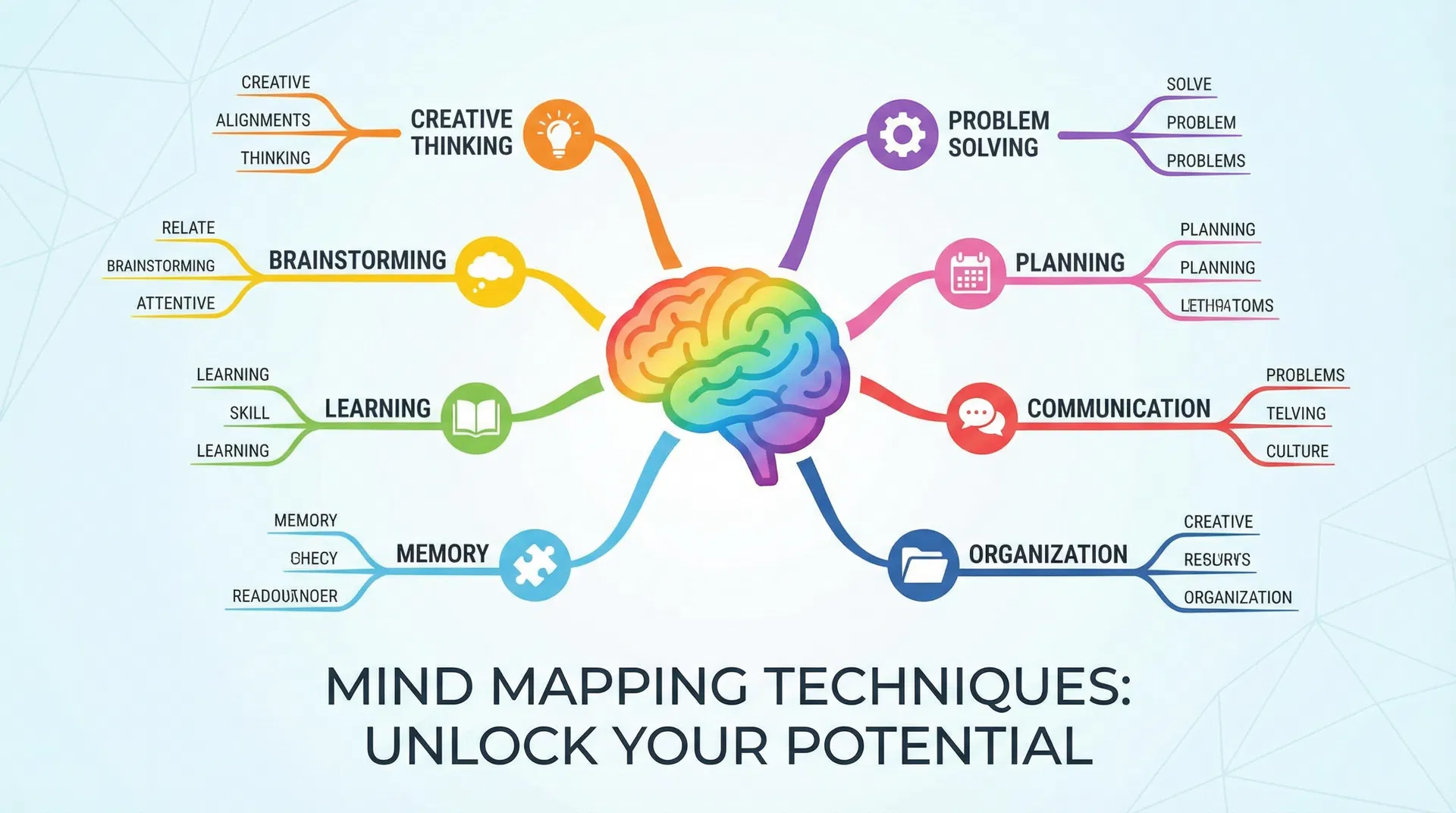
Instead of recording information in long, monotonous lists or continuous text, Mind Mapping uses a radial, hierarchical structure. At its center is a main topic, from which branches with sub-topics, ideas, and connections diverge – similar to the nerve cells in our brain or the branches of a tree. This structure allows complex relationships to be grasped at a glance while not losing sight of the details.
The goal is to imitate and support the natural working of the brain. Our brain operates in a complex network of associations, images, and emotions. Mind Maps are a direct translation of these internal thought processes onto paper or screen, which significantly facilitates learning and recall.
The Core Principles of Mind Mapping According to Tony Buzan
Tony Buzan defined clear guidelines for creating effective Mind Maps, based on how our brain functions. By observing these principles, you maximize the effectiveness of your Mind Maps:
- Central Image/Theme: The starting point of every Mind Map is a central image or keyword that represents the main topic. It should be striking, colorful, and ideally three-dimensional to immediately activate the brain and create an emotional anchor. The central image is the “starting point” for your brain.
- Main Branches: From this center, the main categories or key concepts branch out. These branches are thicker and organically shaped, not linear, and represent the most important sub-topics. They should be directly connected to the central image.
- Sub-Branches: From the main branches, thinner sub-branches diverge, containing further details, examples, or associated ideas. The branches become progressively thinner the further they are from the center, visually representing the hierarchy.
- Keywords: Instead of full sentences, only single, concise keywords are used. Each word should be on its own line. This promotes association, saves space, and forces you to extract the essence of the information. The brain remembers keywords better than full sentences.
- Images and Symbols: Visual elements are crucial. They help to grasp information faster, retain it better, and activate the right brain hemisphere. Add as many relevant images and symbols as possible.
- Colors: Each main category or main branch can be assigned a distinct color. Colors aid in structuring, distinguishing topics, and activating the right brain hemisphere, which improves recall. Use at least three colors per Mind Map.
- Connections: Arrows, lines, or other symbols can be used to represent cross-connections between different branches or concepts that are not directly hierarchically linked. This visualizes complex relationships and fosters networked thinking.
- Association: Harness the power of association. If an idea related to a branch comes to mind, write it down, even if it doesn't seem to fit perfectly at first glance. You can rearrange or connect it later.
Why Mind Mapping is So Effective: The Scientific Perspective
The effectiveness of Mind Mapping is no coincidence; it is deeply rooted in the functioning of our brain. Tony Buzan based his method on insights from neurobiology and psychology. Let's take a look at the scientific reasons why Mind Maps work so well:
1. Holistic Brain Activation (Left-Brain/Right-Brain Integration)
Our brain consists of two hemispheres, each specialized for different functions:
- The left brain hemisphere is primarily responsible for logic, language, numbers, analysis, sequence, and linear thinking.
- The right brain hemisphere is responsible for creativity, images, colors, rhythm, spatial thinking, holism, and associations.
Traditional notes, consisting of long texts and lists, primarily engage the left brain hemisphere. Mind Maps, however, consciously use elements such as images, colors, spatial arrangement, and associations to activate the right brain hemisphere as well. This holistic brain activation leads to deeper processing and storage of information. Studies, such as those by Dr. Roger Sperry (Nobel laureate in medicine), who researched the functions of the brain hemispheres, underscore the importance of integrating both sides for optimal cognitive performance. When both hemispheres work together, the brain's ability to process, store, and retrieve information increases exponentially.
2. Associative Thinking and Memory Enhancement
Our memory doesn't function like a linear database but like a vast, interconnected spiderweb. Information is not stored in isolation but linked by countless associations. The more connections a concept has, the easier it is to retrieve.
Mind Maps are the perfect representation of this associative principle. By visualizing connections between different concepts, you create a rich network of associations. If you later want to recall a piece of information, you can access it via various paths. This is supported by the theory of semantic networks in cognitive psychology, which states that our knowledge is organized into interconnected nodes. The denser and more diverse these connections, the more robust the memory. Mind Maps actively help you forge and strengthen these connections.
3. Reduction of Information to Key Concepts (Chunking)
The compulsion to use only keywords and short phrases promotes focus on the essentials. This helps to manage the flood of information and extract the core ideas of a topic. Instead of memorizing entire sentences, you internalize the essence of a concept, which promotes understanding and long-term retention. Research on cognitive load (Cognitive Load Theory) shows that reducing irrelevant information significantly improves learning performance. Mind Maps force you to break down information into smaller, more digestible units—so-called “chunks”—which relieves the capacity of your working memory and facilitates transfer to long-term memory.
4. Visual Clarity and Structure (Gestalt Principles)
Complex topics can be clearly presented on a single Mind Map. This allows you to maintain the overall overview while still recognizing the details. The spatial arrangement helps the brain intuitively grasp hierarchies and relationships. The human brain is naturally programmed to recognize patterns and structures—Mind Maps optimally leverage this ability. Psychological principles such as the Gestalt Principles (e.g., proximity, similarity, closure) explain how our brain assembles visual elements into meaningful wholes. The organic structure of a Mind Map corresponds to these natural perception patterns, which promotes understanding and recall.
5. Promotion of Creativity and Problem Solving
The open, non-linear structure of a Mind Map invites free association and the generation of new ideas. There are no rigid rules that restrict the flow of thought. This is particularly useful for brainstorming or finding solutions to complex problems. By visually connecting ideas, you often discover unexpected relationships and innovative solutions. The visual nature stimulates creative thought processes and enables out-of-the-box thinking.
6. Active Learning and Metacognition
Creating a Mind Map is an active learning process. You must analyze, synthesize, and structure information. This active engagement with the learning material leads to a deeper understanding than passive reading. Furthermore, Mind Mapping promotes metacognition, i.e., thinking about one's own thinking and learning. You become more aware of how concepts relate and how best to understand and retain them.
Step-by-Step to the Perfect Mind Map: A Practical Guide
Creating a Mind Map is an art perfected with practice. Follow these instructions to create your own effective and engaging Mind Maps:
Choosing Your Materials: Analog or Digital?
Before you begin, decide on your medium:
- Analog (Paper and Pens): Ideal for beginners, it fosters creativity and a tactile experience. You'll need a large, unlined sheet of paper (at least A3), colorful pens (at least 4 colors), and your imagination.
- Digital (Software/Apps): Offers flexibility for editing, sharing, and saving. Popular tools include FreeMind, XMind, MindMeister, Miro, or even simple drawing programs. Digital tools are especially useful for collaborative projects or if you need to update your Mind Maps frequently.
The 7 Steps to Your Mind Map:
- Start in the Center: Orient your paper horizontally (landscape format) or open your digital tool. Draw or place a central image or a concise keyword in the middle. This image should clearly and appealingly represent the main theme of your Mind Map. It should contain at least three colors and capture the essence of the topic. Example: For “Learning Strategies,” you could draw a brain with gears or an open notebook.
- Develop the Main Branches: From your central image, draw thick, organically curved branches leading to the most important sub-topics or main categories. Each main branch should have its own color and bear a single, large keyword written on the line. The branches should be directly connected to the central image and taper outwards. Example: For “Learning Strategies,” main branches could be: “Active Recall,” “Mind Mapping,” “Breaks,” “Environment.”
- Add Sub-Branches: From each main branch, now branch out thinner sub-branches for further details, examples, or specific concepts belonging to that sub-topic. Again: each keyword on its own line. The color of the sub-branch should match that of the main branch from which it diverges. Example: Under “Active Recall,” sub-branches could be: “Spaced Repetition,” “Self-Testing,” “Explaining.”
- Use Keywords: Consistently limit yourself to single, meaningful keywords. Avoid full sentences. This forces you to condense information and grasp its essence. The brain associates much better with individual words and images than with long blocks of text.
- Integrate Images and Symbols: Wherever possible, add small images, sketches, or symbols that visually reinforce the keywords or concepts. A small lightbulb symbol next to “Ideas” or a book next to “Reading” can significantly improve recall. Images are the language of the brain and are processed up to 60,000 times faster than text.
- Use Colors Purposefully: Use colors not only for the main branches but also to highlight specific information, form groups, or add emotional accents. For example, a certain color could always represent “Problems,” another for “Solutions.”
- Make Connections: If there are relationships between different branches or sub-branches that are not hierarchical, draw arrows or lines between them and label them if necessary. This visualizes complex relationships and promotes networked thinking. Example: An arrow from “Breaks” to “Concentration.”
Tips for Optimizing Your Mind Maps:
- Be creative: Let your imagination run wild. The more personal and creative your Mind Map is, the better your brain will store it.
- Keep it organic: Avoid straight lines and right angles. Your brain prefers organic, flowing shapes.
- Revise and expand: A Mind Map is rarely perfect on the first try. It is a living document. Expand and refine it as you gain new information or develop new ideas.
- Mind Map by hand: Especially at the beginning, drawing by hand promotes neural networking more strongly than digital tools.
- Review regularly: Look at your Mind Maps regularly to keep the knowledge actively in your memory. This is a form of active recall.
Applications of Mind Mapping: More Than Just a Learning Method
Mind Mapping is a universally applicable technique that goes far beyond mere learning. Its ability to structure complex information and initiate creative processes makes it a valuable tool in many areas of life.
1. Study and School: The Learning Booster
- Create Summaries: Convert lecture notes, book chapters, or research articles into concise Mind Maps. You filter out the essentials and create a visual overview for exams.
- Exam Preparation: Create a master Mind Map for each exam subject, covering all relevant topics and sub-topics. This helps you maintain an overview and identify knowledge gaps.
- Plan Papers and Presentations: Structure your arguments, gather ideas, and organize your sources. A Mind Map can help you develop a clear outline and stay focused.
- Learn Languages: Visualize vocabulary, grammar rules, or conversation phrases. Connect new words with images or concepts you already know.
2. Work and Career: Efficiency and Innovation
- Project Planning: Break down complex projects into manageable task packages, identify dependencies, and assign responsibilities. A Mind Map provides an excellent visual project overview.
- Brainstorming and Idea Generation: Whether for a new product, a marketing campaign, or solving an internal problem – Mind Maps are the ideal tool for letting ideas flow freely and structuring them. The non-linear structure encourages unconventional thinking.
- Meeting Minutes and Presentations: Record the most important points of a meeting or visually structure your presentation. This helps you focus on the essentials and present your arguments clearly.
- Strategy Development: Visualize business models, SWOT analyses, or competitive landscapes to make complex strategic decisions.
3. Personal Development and Everyday Life: Clarity and Structure
- Goal Setting and Planning: Visualize your personal or professional goals, the steps you need to take, and potential obstacles. A Mind Map can help you clearly define your goals and create an action plan.
- Decision Making: When faced with an important decision, you can record pros and cons, potential consequences, and alternatives in a Mind Map. This creates clarity and helps you make an informed decision.
- Creative Writing: Develop characters, plotlines, or settings for stories or screenplays. The associative nature of the Mind Map is perfect for unfolding creative ideas.
- Travel Planning: Organize destinations, activities, accommodations, and budgets. A Mind Map can help you plan your dream trip in detail.
- Self-Reflection: Use Mind Maps to visualize your thoughts, feelings, or problems. This can help you recognize patterns and find solutions.
Common Mind Mapping Mistakes and How to Avoid Them
Although Mind Mapping is intuitive, there are some pitfalls that can reduce its effectiveness. Pay attention to these points to get the most out of your Mind Maps:
- Too Much Text: The biggest mistake. Mind Maps thrive on keywords, not full sentences. If you write too much, your Mind Map becomes cluttered and loses its associative power. Solution: Reduce each branch to a single, concise keyword. If you need more details, create another sub-branch.
- Linear Structure: The goal is to break linearity. Straight lines and lists make your Mind Map rigid and less brain-friendly. Solution: Use curved, organic branches that spread naturally from the center.
- Lack of Colors and Images: A Mind Map without colors and images is like a black and white film – it loses appeal and activation potential for the right brain hemisphere. Solution: Use at least three colors for main branches and add as many relevant images or symbols as possible.
- Cluttered Arrangement: If branches cross or are too close together, the Mind Map becomes difficult to read. Solution: Ensure ample space between branches. Try to arrange the branches radially so they don't overlap.
- No Central Image: The central image is the anchor point of your Mind Map. Without it, an important visual and emotional focus is missing. Solution: Always start with a clear, colorful, and meaningful central image.
- Too Much Information at Once: Don't try to cram an entire textbook onto a single Mind Map. This leads to overwhelm. Solution: Focus on one specific topic per Mind Map. For very extensive topics, you can create multiple Mind Maps and link them (e.g., with cross-references).
- No Connections Between Branches: If relevant cross-connections are missing, you miss an important aspect of networked thinking. Solution: Be attentive to relationships between different topic areas and visualize them with arrows or lines.
Conclusion: Unleash Your Full Learning Potential with Mind Mapping
Mind Mapping is far more than just a note-taking technique; it is a holistic method that optimally utilizes your brain's natural abilities. By structuring information visually, associatively, and hierarchically, you activate both brain hemispheres, improve your memory, foster creativity, and gain a deeper understanding of complex relationships. From efficient exam preparation to creative brainstorming and personal goal setting – the applications are almost limitless.
Science confirms the effectiveness of this method: by reducing information to keywords, using colors and images, and promoting associative thinking, cognitive load is reduced, and long-term memory storage is significantly improved. It is an active learning process that encourages you to reflect on what you have read and place it in a larger context.
Start integrating Mind Maps into your daily life today. You will quickly discover how this simple yet ingenious technique can revolutionize the way you learn, think, and solve problems. It's time to unleash your brain's superpower and reach your full potential.
Want to apply these techniques directly? With LernPilot, you can learn with AI support and optimize your learning strategies.
Ready to deepen this knowledge?
Upload your materials and LernPilot automatically creates flashcards, quizzes, and a personalized study plan.
No credit card required • Cancel anytime