Preventing Study Burnout: Recognizing Warning Signs & Taking Effective Action
Want to actively learn this topic?
LernPilot automatically creates quizzes, flashcards, and summaries from any topic.
Preventing Study Burnout: Recognizing Warning Signs and Taking Effective Action
Imagine sitting over your books for hours, but the information just won't stick. You're tired, frustrated, and the feeling that all your efforts are in vain gnaws at you. What you're experiencing could be study burnout – a widespread yet often underestimated phenomenon affecting students and learners of all ages. In a world that places ever-higher demands on us, the pressure to constantly perform is immense. But this pressure can push us to our limits and severely impair our ability to learn.
This article is your comprehensive guide to understanding study burnout, recognizing its warning signs early, and developing both preventive and reactive strategies. We'll delve deep into scientific findings, provide concrete examples from daily learning, and offer practical, immediately applicable tips. Our goal is to show you how to learn smarter, not harder, to protect your health while achieving your academic goals. Get ready to fundamentally rethink your study habits and establish a healthier, more effective learning routine.
The Invisible Danger: What Is Study Burnout, Really?
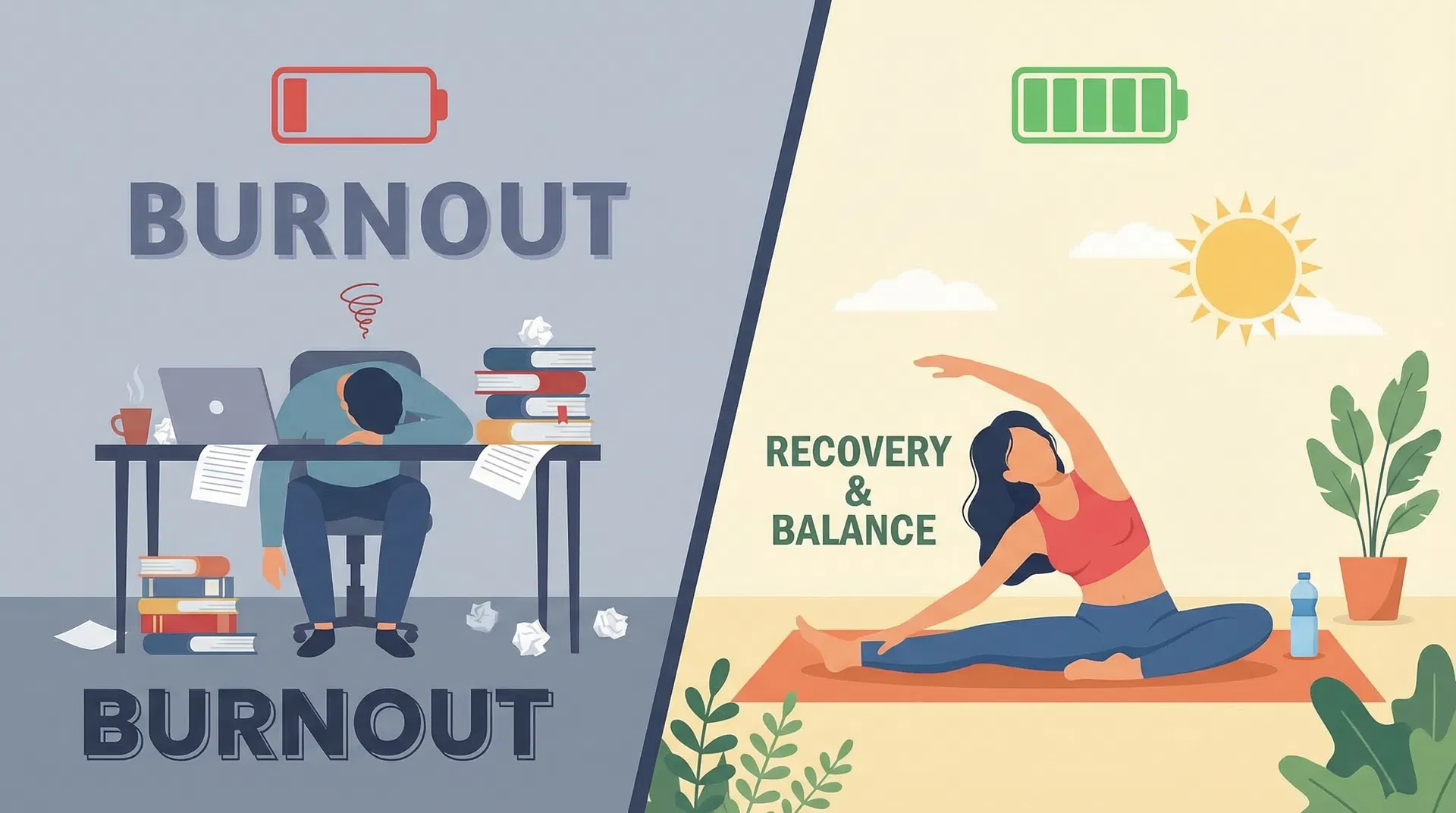
Study burnout is more than just fatigue or temporary stress. It's a state of emotional, mental, and physical exhaustion caused by prolonged and excessive study stress. Similar to professional burnout that occurs in work contexts, study burnout manifests through specific symptoms that severely impair performance and well-being. Studies show that a significant proportion of students – sometimes up to 30% or even more in certain degree programs – suffer from burnout symptoms. The consequences range from poorer grades and dropping out of studies to serious psychological problems.
The Three Dimensions of Burnout Syndrome in a Learning Context
The concept of burnout was originally developed by Christina Maslach and Susan Jackson and comprises three core components that can also be applied to the learning context:
- Emotional Exhaustion: This is the central component. You feel emotionally drained and empty, as if your energy reserves are completely depleted. Even after periods of rest or sleep, you don't feel truly recovered. The act of studying itself feels extremely strenuous.
- Cynicism/Depersonalization: You develop a negative, detached, or even cynical attitude towards your studies or learning content. The initial enthusiasm gives way to indifference or even aversion. You no longer see the purpose in learning and perceive your tasks as meaningless or bothersome.
- Reduced Personal Accomplishment: Despite intense studying, you feel like you're achieving nothing or can no longer reach your goals. Your concentration suffers, memory performance declines, and you doubt your own abilities. This leads to a vicious cycle of frustration and even more effort, which, however, does not yield the desired results.
These three dimensions interact and reinforce each other, leading to an ever-deeper immersion into the state of burnout.
The 5 Alarming Warning Signs: Do You Recognize Them in Yourself?
It's crucial to recognize the signs of impending study burnout early. The sooner you react, the easier it is to counteract it. Pay attention to the following symptoms:
- Chronic Exhaustion: You feel constantly tired, even after sufficient sleep. Your body and mind no longer seem to regenerate properly. Getting up is difficult, and the thought of the upcoming study day is already exhausting. This is often the first and clearest warning sign.
- Cynicism and Loss of Motivation: The initial enthusiasm for your subject or learning goals has vanished. You feel a deep indifference or even aversion to the study material. Questions like "What's the point of all this?" or "Does this even make sense?" frequently arise. You feel internally empty and disinterested.
- Decline in Performance Despite Increased Effort: You invest more time and energy in studying than ever before, but your grades are worsening, or you feel like you understand less. The efficiency of your learning drastically decreases, leading to even more frustration and a feeling of helplessness.
- Massive Concentration Problems: Your attention span shrinks rapidly. You can barely concentrate on a task for more than 10-15 minutes, you drift off, and are easily distracted. Reading a text requires multiple repetitions because you cannot grasp the content. This affects not only studying but also other daily tasks.
- Physical Symptoms: Your body reacts to chronic stress. Frequent headaches, migraines, sleep disturbances (difficulty falling and staying asleep), digestive problems (gastrointestinal complaints), increased susceptibility to infections, or muscle tension are typical signs. These psychosomatic complaints are a cry for help from your body.
Self-Check: If you observe several of these symptoms over a longer period, you should take urgent action.
The Root of the Problem: Why Does Study Burnout Occur?
Study burnout rarely develops overnight. It is the result of a combination of individual factors, external pressure, and inefficient learning strategies. Understanding these causes is the first step toward prevention.
1. Perfectionism and Unrealistic Expectations
The desire to understand everything perfectly, achieve the best grades, and make no mistakes is a double-edged sword. While a certain degree of ambition can be motivating, excessive perfectionism often leads to:
- Endless Reworking: You are never satisfied with your results and invest disproportionately much time in details that make little difference.
- Fear of Failure: The fear of not being good enough paralyzes you and leads to procrastination or the feeling of never being finished.
- Unrealistic Goals: You set impossibly high standards for yourself, which inevitably lead to disappointment and frustration.
2. Lack of Breaks and Insufficient Regeneration
The brain is not an tireless engine. It needs regular breaks to process information, recover, and recharge. Those who study continuously without taking breaks risk not only a drop in performance but also an overload of the nervous system. Studies on neuroplasticity show that sleep and rest periods are crucial for consolidating learned material.
3. Inefficient Learning Methods
Many learners resort to passive learning strategies that, while time-consuming, are not very effective. These include:
- Pure Reading and Highlighting: These methods convey a deceptive feeling of understanding without actively embedding the knowledge.
- Rote Memorization: Without context and connection to existing knowledge, what is learned is quickly forgotten.
- Last-Minute Learning (Cramming): Trying to cram everything in just before exams leads to superficial knowledge and high stress.
4. Social and External Pressure
Comparison with fellow students, expectations from family and lecturers, as well as pressure from scholarships or the fear of dropping out of studies can be an enormous burden. Social media often exacerbates this pressure by presenting an idealized world of success and productivity.
5. Lack of Balance and Neglect of Well-being
If life consists only of studying, and hobbies, social contacts, sports, and sleep are neglected, the system becomes unbalanced. A lack of balance leads to a loss of quality of life and resilience, which drastically increases susceptibility to burnout.
7 Effective Countermeasures: Your Path to Sustainable Learning
It's time to take action and reshape your study habits. The following strategies will help you prevent study burnout and lead a healthy, productive learning life.
1. Breaks Are Mandatory: The Power of Regeneration
Regular breaks are not wasted time; they are essential for effective learning and burnout prevention. Your brain needs these breaks to process information and recover.
- The Pomodoro Technique: This proven method is an excellent starting point. Study intensely for 25 minutes, then take a 5-minute break. After four such cycles (a total of 2 hours of study time), treat yourself to a longer break of 20-30 minutes. During the short breaks, you should step away from your study material, stand up, stretch, or drink something. During the long break, you can take a short walk, prepare a meal, or briefly distract yourself. The Pomodoro Technique helps maintain focus and prevent overwhelm.
- Micro-breaks: Even brief glances out the window, a few deep breaths, or consciously relaxing your shoulders can work wonders if you notice your concentration waning.
- Active Breaks: Use longer breaks not just for relaxation, but also for light physical activity. A short walk in the fresh air or a few stretching exercises can clear your head and promote blood circulation.
2. Utilize More Efficient Methods: Learn Smarter, Not Harder
Say goodbye to passive learning strategies and embrace active methods that challenge your brain and sustainably embed what you've learned.
- Active Recall: Instead of just reading, try to retrieve what you've learned from memory. Read a section, close the book, and try to summarize or write down the key points in your own words. Use flashcards to quiz yourself. Studies like those by Roediger and Karpicke (2006) have shown that active recall is significantly more effective than mere re-reading.
- Spaced Repetition: Review study material at increasingly longer intervals. Tools like Anki or LernPilot use this principle to present flashcards to you precisely when you are most likely to forget them. This optimizes the learning process and reduces overall effort.
- Elaborate and Teach (Feynman Technique): Try to explain complex concepts to someone else (or to yourself in thought) as if that person had no prior knowledge. This forces you to truly grasp the material and identify gaps in your understanding.
- Mind Mapping: Visualize connections and structure information hierarchically. Mind maps help simplify complex topics and recognize the bigger picture.
3. Set Realistic Goals: The Journey Is the Reward
Overblown expectations are a major driver of frustration and burnout. Learn to realistically assess your goals and let go of the idea of perfectionism.
- SMART Goals: Formulate your learning goals to be Specific, Measurable, Attainable, Relevant, and Time-bound. Instead of
Ready to deepen this knowledge?
Upload your materials and LernPilot automatically creates flashcards, quizzes, and a personalized study plan.
No credit card required • Cancel anytime