Time Management for Students: The Best Strategies
Want to actively learn this topic?
LernPilot automatically creates quizzes, flashcards, and summaries from any topic.
Time Management for Students: 7 Strategies That Really Work
The semester has just started and you already feel like you're behind. Lectures, seminars, homework, part-time work - and at some point you should also learn. Does that sound familiar?
Good time management isn't an innate ability — it's a skill you can learn. Here are 7 strategies that are scientifically proven and tried and tested.
1. The Eisenhower Matrix: Important vs. Urgent
Not everything that seems urgent is actually important. Divide your tasks into four categories:
| Urgent | Not urgent | |
|---|---|---|
| Important | Do it immediately | Plan & Schedule |
| Not important | Delegate | Eliminate |
Example: Your study group's WhatsApp message feels urgent, but exam preparation is more important.
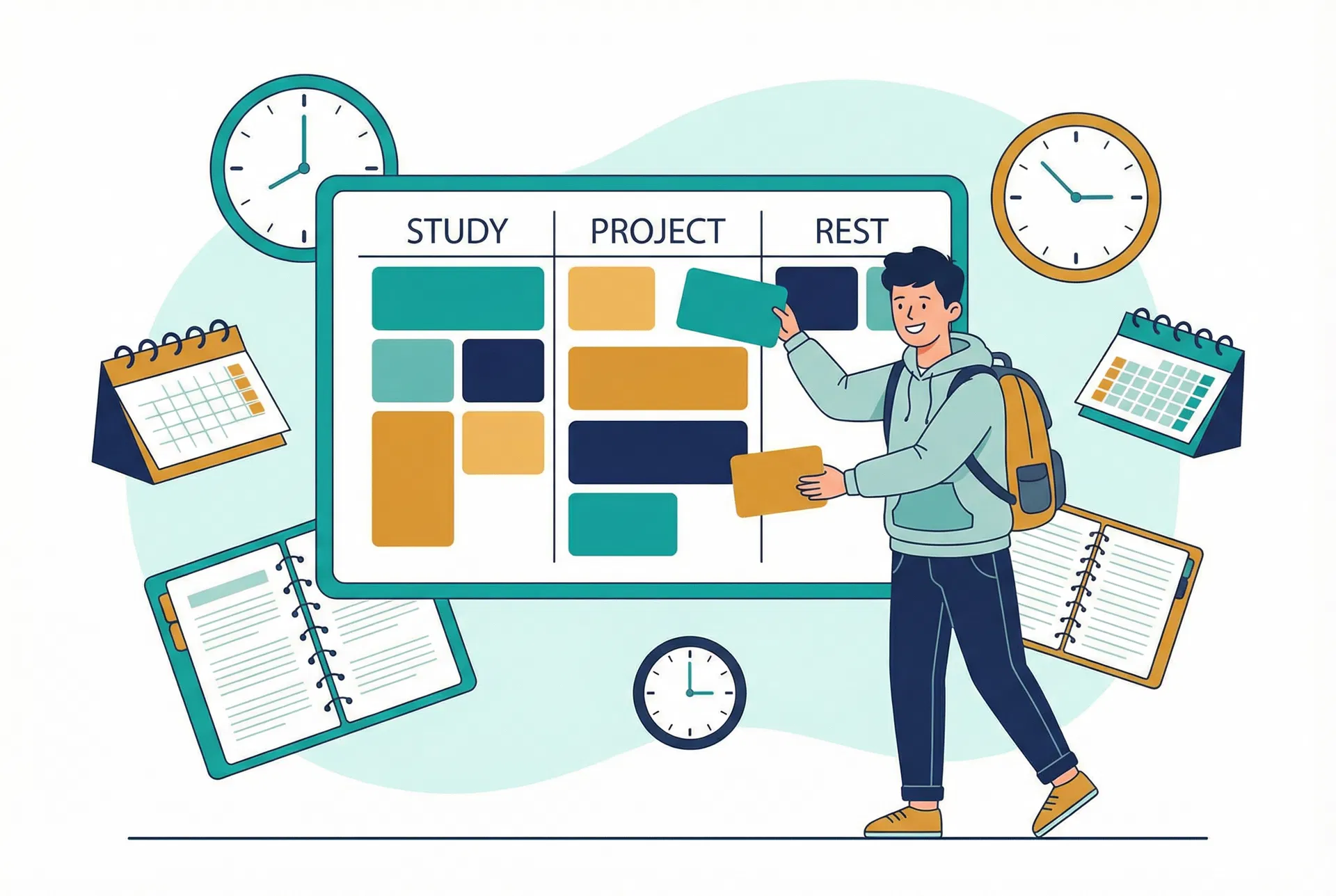
2. Time Blocking: Fixed learning times
Block specific times in your calendar just for studying - like an appointment that you don't cancel.
How it works:
- Monday 9-11 a.m.: Statistics
- Tuesday 2-4 p.m.: Macroeconomics
- Wednesday 10 a.m. - 12 p.m.: Law
The trick: Your brain gets used to the rhythm and switches to “learning mode” more quickly.
3. The 2-minute rule
If a task takes less than 2 minutes, complete it immediately. This prevents small tasks from piling up into a mountain.
4. Eat the Frog: Hardest thing first
Mark Twain said, "If you eat a frog first thing in the morning, the rest of the day will be better." Do the most difficult or unpleasant task first — everything will feel easier afterwards.
5. The Pomodoro Technique
25 minutes of focused study, 5 minutes break. After 4 rounds, take a longer break of 15-30 minutes.
Why this works:
- Your brain can concentrate fully for a maximum of 25-45 minutes
- Regular breaks prevent mental exhaustion
- The timer creates positive time pressure
Tip: LernPilot has a built-in Pomodoro timer with statistics!
6. Batch Processing: Summarize similar things
Group similar tasks together and complete them in one go:
- Reply to all emails at once
- Create all flashcards for a week at once
- Follow up on all lecture notes on Friday evening
This saves time because your brain doesn't have to constantly switch between different types of tasks.
7. The 80/20 rule (Pareto principle)
80% of your results come from 20% of your activities. Figure out which 20% of your study time has the most impact and focus on that.
Example: Instead of spending 10 hours reading through lecture slides, invest 2 hours in active practice with old exams - this will give you more benefit for the exam.
Bonus: Weekly planning
Take 15 minutes every Sunday evening:
- What's coming up this week? (Deadlines, exams, appointments)
- What are the 3 most important tasks?
- When will I learn something? (set time blocks)
Conclusion
Time management doesn't mean scheduling every minute. It means consciously choosing what you spend your time on. Start with a strategy that appeals to you and gradually add more.
© 2026 LEIT Smart Solutions GmbH. All rights reserved.
Ready to deepen this knowledge?
Upload your materials and LernPilot automatically creates flashcards, quizzes, and a personalized study plan.
No credit card required • Cancel anytime