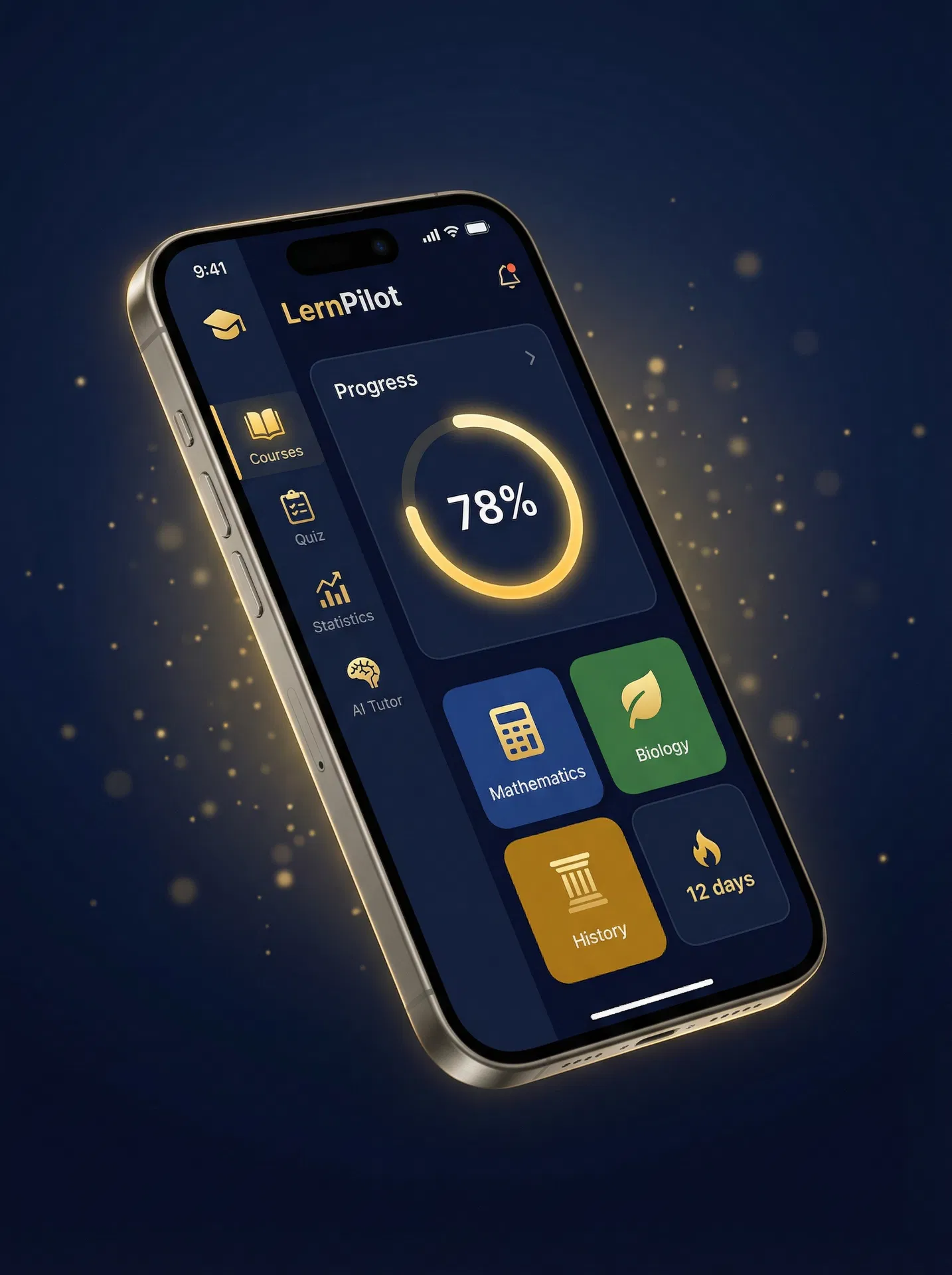
AI-supported exam preparation: Tools & methods for learning success
Discover how AI is revolutionizing your exam preparation: from personalized learning paths to intelligent quiz generators. Optimize your learning strategies based on science and achieve top results. Including practical tips for everyday learning.
AI-supported exam preparation: Your smart path to learning success
Imagine being able to prepare for exams that are perfectly tailored to your individual needs. A system that knows exactly where your strengths lie and where you still need support. That not only asks questions, but also explains to you why your answer was wrong and then repeats yourself intelligently until the knowledge sits. What sounded like a dream of the future just a few years ago has now become reality thanks to artificial intelligence (AI).
Exam preparation can be one of the most stressful times in your learning life. Mountains of learning material, the pressure to remember everything and the uncertainty as to whether you have really understood everything important. Traditional learning methods, such as passive reading and mindless memorization, are often inefficient and quickly lead to frustration. But what if you had a powerful technology at your side that supports and relieves you on your way to learning success?
In this in-depth article, we delve deep into the world of AI-powered exam preparation. You will understand which scientific principles underlie effective learning and how AI can optimally use these principles for you. We will introduce you to concrete tools and methods, show you how to integrate them into your everyday learning routine, and highlight where the human component remains indispensable even in the age of AI. Get ready to revolutionize your study strategies and ace exams with more confidence and better results.
The science behind effective test preparation: Why traditional methods often fail
Before we dive into the modern possibilities of AI, it's important to understand why many of us struggle with traditional test preparation. The answer lies in cognitive science and the peculiarities of our brains.
Cognitive load and the Ebbinghaus effect
Our brain is not an infinite hard drive. If we try to absorb too much information at once, our working memory quickly reaches its limits. This is called cognitive overload. The result? We only retain a fraction of what we learn. There is also the famous Ebbinghaus effect, named after the German psychologist Hermann Ebbinghaus. His research showed that we forget much of the newly learned knowledge after a short time if we don't repeat it. The forgetting curve is steep, especially in the first few hours and days after learning. Simply rereading the material is often not enough to effectively counteract forgetting.
The limits of passive learning
Many students and pupils tend to passive learning: They read textbooks, highlight passages of text or simply copy down notes. While these methods suggest a feeling of productivity, they are scientifically proven to be less effective than active learning strategies. When we passively consume information, our brain is not sufficiently challenged to process, connect and store what we have learned. There is a lack of deep elaboration and active recall - two of the most powerful tools for sustained learning.
The problem is that while our human brains are incredibly powerful, they are also prone to confirmation bias and are often inefficient when it comes to determining the optimal time for repetition or selecting the appropriate learning content. This is where AI comes into play. It can address exactly these weak points and offer us a tailor-made learning environment that takes into account the latest findings in learning psychology.
AI as your personal learning coach: Revolutionary approaches
AI systems can analyze enormous amounts of data and use them to recognize patterns that often remain invisible to the human teacher or learner. This ability makes it an invaluable companion in your exam preparation. Think of AI not as a replacement for your own thinking, but as an intelligent assistant that helps you learn more efficiently, more motivated and more successfully.
Personalized learning paths: Recognize individual strengths and weaknesses
Everyone learns differently. What works for one person may be ineffective for another. AI-supported adaptive learning systems, like LernPilot, can start right here. They analyze your interactions, your answers to questions, the time it takes you to do so, and your mistakes. On this basis, they create a detailed profile of your knowledge and learning patterns. This allows the AI to generate a personalized learning path for you that:
- Focuses: Topics that you have mastered well are repeated less often, while if there are gaps in your knowledge, you practice more intensively.
- Difficulty level adjusted: Tasks are dynamically adjusted to your current performance level so as to neither under nor overwhelm you (Vygotsky's Zone of Proximal Development concept).
- Recommendations are available: The AI can suggest learning resources, explanatory videos or additional exercises tailored to your specific needs.
The result is a highly efficient and motivating learning experience that feels like you have a private teacher who is there for you 24/7.
Active recall and spaced repetition in the age of AI
Active Recall is one of the most effective learning strategies. Instead of reading information passively, you try to recall it from memory (e.g. through self-tests, flashcards, or summarizing without notes). Studies such as those by Roediger and Karpicke (2006) have shown that active retrieval significantly improves information retention. AI tools can revolutionize this process:
- Smart flashcards and quiz generators: AI can automatically generate questions and answers or create fill-in-the-blank texts from your learning materials. She can even ask open-ended questions that encourage you to think more deeply.
- Spaced Repetition: This is a method in which learning content is repeated at increasingly longer intervals before it is forgotten. AI algorithms are masters at calculating the optimal time for each repetition - exactly based on your individual forgetting curve for each individual piece of information. You no longer have to worry about when to repeat what; the AI plans it for you. This saves a tremendous amount of time and maximizes retention performance.
Feedback and error analysis: Immediate understanding
Imagine making a mistake and getting not only the correct answer, but a detailed explanation that shows you exactly where your thinking error was and how you can do it better. AI can do exactly that.
- Detailed Feedback: For multiple choice questions, the AI can not only tell you the right option, but also explain why the other options are wrong and the concepts behind them.
- Insight into thought processes: For more complex tasks or free text input, advanced AIs can even try to analyze your thought process and give you hints on how to improve your reasoning or solution strategy.
- Identification of pattern errors: Over many rounds of practice, the AI can detect whether you keep making the same mistakes on certain topics and specifically suggest them for practice.
This personalized and immediate feedback is critical to learning success, allowing you to quickly correct misunderstandings and build deeper understanding before incorrect assumptions take hold.
Concrete AI tools for your exam preparation
The landscape of AI tools in education is growing rapidly. Here are some categories and examples of how you can use them:
Adaptive learning platforms (e.g. LernPilot)
These are often comprehensive systems that bundle a variety of AI functions. Platforms like LernPilot offer:
- Personalized exercises: Based on your knowledge and progress.
- Progress tracking and analytics: Detailed dashboards show you which topics you have mastered and where you still need to invest work. They visualize your forgetting curve and your learning progress over time.
- Learning Planner: Intelligent algorithms help you create a realistic and effective learning plan that optimally times repetitions.
- Simulated Exams: To prepare you for the exam format and reduce exam anxiety.
- Resource management: You can often upload your own notes, PDFs or lecture slides, which the AI then processes to create exercises based on them.
AI-powered flashcard systems and quiz generators
These tools go beyond traditional digital flashcards:
- Automatic creation: AIs can automatically generate questions, answers and fill-in-the-blank texts from your lecture notes, textbooks or lecture notes. This saves you hours of manual creation.
- Intelligent Repetition: Many of these systems integrate spaced repetition algorithms (such as the SM-2 algorithm) to optimally control repetition intervals. Popular examples are Anki (in combination with AI plugins) or specialized learning apps.
- Various Question Types: AIs can generate multiple choice, true/false, fill-in-the-blank questions, or even short open-ended questions to test your understanding in different ways.
Text summarization and note-taking tools
The flood of information can be overwhelming. AI can help capture the core:
- Automatic Summaries: Tools can turn long texts, articles, or even entire books into concise summaries that highlight only the most important points. This helps you to quickly get an overview and focus on the essentials.
- Keyword Extraction: AIs can identify the most relevant keywords from a text, helping you create flashcards or mind maps.
- Smart Notes: Some tools can digitize your handwritten notes, make them searchable, and even enrich them with additional information or explanations by understanding the context.
Language and explanation AIs
Sometimes you just need a different explanation or an interactive learning session:
- Virtual Tutors: Language models such as GPT-4 can act as virtual tutors. You can ask them questions, have complex topics explained in simple terms, or even have a discussion about a specific material. They can give you examples, find analogies and help you understand connections that would otherwise have remained hidden from you.
- Voice-controlled learning: For language subjects, there are AIs that can correct your pronunciation, query vocabulary and even simulate conversation partners for you.
Writing and proofreading aids
AI tools are a great help for term papers, essays or scientific papers:
- Grammar and style checker: Tools like Grammarly or LanguageTool that are powered by AI can not only detect spelling errors, but also improve your writing style, optimize sentence structures and make suggestions for clearer wording.
- Plagiarism Checker: AI-based software can help prevent unintentional plagiarism by comparing texts with billions of other sources.
- Literature research and source management: Some AIs can help you find relevant academic articles and automatically format your sources.
Practical application: How to integrate AI tools into your everyday learning routine
The best tools are of no use if you don't use them correctly. Here is a step-by-step guide on how to optimally integrate AI-supported test preparation into your everyday learning routine:
-
Define learning objectives and structure material:
- Start by clearly defining which topics and skills you need to master for your exam. Create an outline of the exam material.
- Tip: Use a mind map tool or note-taking app to visualize the scope. AI can even help you here by extracting the main topics from course catalogs or lecture notes.
-
Digitize and consolidate resources:
- Collect all relevant learning materials (textbooks, scripts, lecture slides, your own notes). If possible, convert them to digital, searchable formats (PDF, text documents).
- Tip: Upload these materials to a central learning platform like LernPilot or use text summarization AIs to filter out the most important things.
-
Select and set up AI tools:
- Choose the AI tools that best suit your learning goals and preferred learning style. For comprehensive preparation, an adaptive learning platform like LernPilot is often the best choice as it bundles many functions.
- Tip: Try different tools. Many offer free trial periods.
-
Create personalized learning paths:
- Start with a diagnostic test within your adaptive learning system. This helps the AI determine your starting point.
- Let the AI generate a tailored learning plan for you. This plan takes into account your weaknesses, strengths and the study time available.
- Tip: Stick to the generated plan as much as possible, but be prepared to adjust it if your priorities change.
-
Practice Active Retrieval:
- Make intensive use of the AI-generated flashcards and quizzes. Try to actively recall the answers from memory before seeing the solution.
- Tip: If you can't answer a question, look carefully at the explanation and try to formulate the answer in your own words. The AI can help you by offering you more examples or analogies.
-
Use regular feedback and error analysis:
- Get the AI to give you detailed feedback on your answers. Understand why an answer was right or wrong.
- Tip: Make a list of common mistakes or difficult concepts. Go through this list regularly and ask the AI for additional explanations or exercises on these points.
-
Track learning progress and adjust plan:
- Regularly check your AI learning platform's progress reports and analytics. They show you how good you are in individual subject areas and where you still need to catch up.
- Tip: Use this data to adjust your learning plan if necessary. The AI will often proactively give you suggestions to optimize your plan.
-
Perform exam simulations:
- Use AI to simulate exam-like scenarios. This can improve time management and reduce test anxiety.
- Tip: Try to carry out the simulations under real conditions (e.g. without any aids, under time pressure). Analyze the results carefully with the help of AI.
The human component: Where AI supports but does not replace
As powerful as AI is, it is a tool and not a replacement for human skills. There are areas where your human intelligence, creativity and emotional competence remain indispensable:
- Critical thinking and deeper understanding: AI can provide facts and give explanations, but questioning, analyzing and synthesizing information at a meta-cognitive level remains your job. The ability to apply what you have learned to new, unknown problems, to combine different perspectives and to develop your own, original ideas is a core competency that goes beyond pure factual knowledge.
- Creativity and Innovation: AI can recognize existing patterns and generate new content in the style of known patterns. However, true, groundbreaking creativity and innovation that goes beyond what exists and creates new paradigms comes from the human spirit.
- Emotional intelligence and social skills: Exams are often also a question of emotional resilience, dealing with stress and self-motivation. These aspects, as well as interacting with fellow students and teachers, working in teams and developing empathy, are purely human domains that AI cannot replace.
- Meta-learning: The ability to think about one's own learning, to consciously select and adapt learning strategies (the